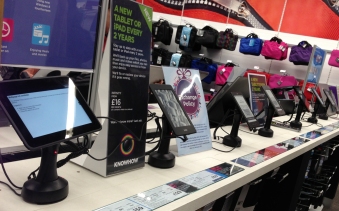
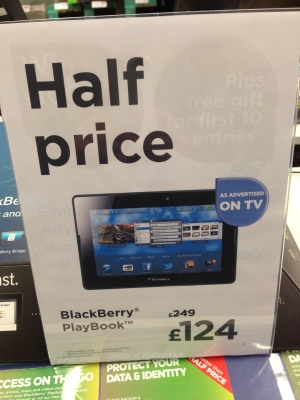
On a recent visit to Best Buy and PC World at Purley Way in Croydon, these were the tablets that you could actually see - and in many cases play with. I've put the best, first, so this is a Top Ten. In fact there were only ten, but this is more tablets than have been available in one place up to now.
If you're looking for jam today, the iPad is still the dominant force, especially now the new version is available. It has the looks, the kudos, the smooth running and the best selection of apps. Of course you pay a high price, you agree to live for ever inside Apple's "walled garden" and the cameras are rubbish, but it's the integration that still makes the iPad the best tablet around. That and the fact that with so many other people having iPads, sharing and communicating is just that bit easier. Remember, though, that you don't get the Flash video player. Apart from Youtube, Flash also powers the twiddly bits of some serious websites - for instance Google Finance.
This was the first tablet released with Google's special-for-tablets platform, Android 3.0 Honeycomb. As such, it benefits from Motorola and Google having worked closely together on the product, but unfortunately, as the first to market, it also suffers from being a bit of a work-in-progress machine. Reviews have been pretty poor, as, apparently, have sales. At first, the all important Flash player was missing, and the tablet couldn't access a card placed in its memory card slot. There are still issues, but on the day, this was the smoothest of the Android 3 tablets I tested - bigger and heavier than the iPad, but still a sight more convenient than a laptop and with far better battery life. Android 3 itself, begins to feel as if it will more feature-rich than the iPad once the rough edges have been resolved. You may well find that you have to fiddle around updating the platform for any Android 3 tablet bought over the next couple of months, but after that, the future's bright.
This is a little bigger and fatter than the Xoom, and also perhaps a little cheaper-feeling. But these are small and subjective points, and if you don't have the tablets side by side, you probably wouldn't notice. The particular unit I've tested was a little jerky but this wasn't really a serious problem. On the plus side, the Iconia has a proper USB 2.0 host socket - not just the small one. You can apparently plug in a keyboard or even a memory stick and use these as normal. This could be a decider in favour of this tablet for many people.
This is the second best selling tablet after the iPad, but it's number 4 in the list here because it's getting a little out of date. It is a 7-inch tablet running Android 2.2 (called Froyo). Google said that Froyo was not sufficient to run a tablet, but I think that the Tab really proves that it can work for this size screen, and work pretty well. Samsung have added a couple of specific apps, particularly for handling Email and contacts and these help make proper use of the whole screen. This was the first tablet to run Flash and as it's currently the most popular, accessories are reasonably easy to come by. However, their quality is very variable. If the Galaxy Tab has one big drawback, it is its proprietary connector. They just have not sold enough Tabs to make this connector anything other than a big handicap. Click here for our full review.
Perhaps surprisingly, Archos tablets are third in the world sales table with a 2% market share in 2010. This is partly because Archos sell some products which are on the crossover between being a tablet and being an MP3 player, but Archos sell them as tablets. This 7" tablet runs Android 2.2 and is perhaps a good choice amongst the cheaper tablets. It's small enough to slip into a jacket pocket, it has a respectable battery life, reasonable performance and a handy kick-stand so that you can stand it up on the table in Starbucks. Archos tablets also have a good name for being able to cope with a range of media and video formats.
This is better than you might expect for an Android 2.2 tablet that's exclusive to Best Buy and Carphone Warehouse (which are effectively the same shop).
Again an Android 2.2, 10" tablet; this time exclusive to PC World and Curry's (which are effectively the same shop). It came out last year - and while it was quite well received at the time, this tablet really shows how Froyo (Android 2.2) while it works for the 7" Galaxy Tab, looks rather silly when upscaled to a 10" screen. (Because the measurements are diagonal, a 10" screen is roughly double the size of a 7".)
This 7" tablet runs Android 2.1 and comes as part of an eStation printer, which explains the high sale price. It's supposed to be a "detachable 17.8cm full-colour touchscreen web browser" because HP made a strategic decision to sell only tablets running on the WebOS platform that they bought along with Palm last year. When this was going to be an Android tablet, it was going to be called a Zeen. Perhaps that comes from the word Magazine? It is a funny shape, rather heavy and the familiar Android environment is rather hard to find. But it's safe to assume that it will do a better job of printing than most of the other tablets.
10) Binatone
7" tablet running Android 1.5. This is the only resistive type screen amongst those on offer. It's a very poor product and should really be ignored. It only makes it to our Top Ten by virtue of the fact that there were only ten tablets on offer during this test of the market. Had there been 501 tablets available, this might not have made it to the top 500. It's cheap from Best Buy, but at this moment, even cheaper from Asda.